

Advanced Prostate Cancer Diagnosis & Treatment in Dallas-Fort Worth (DFW)
Receiving a prostate cancer diagnosis can feel overwhelming. As a founding partner of Urology Partners of North Texas (UPNT), my goal is to replace that uncertainty with understanding. We’ll take time to explain your specific diagnosis, test results, and every treatment option available—so you can make informed, confident decisions.
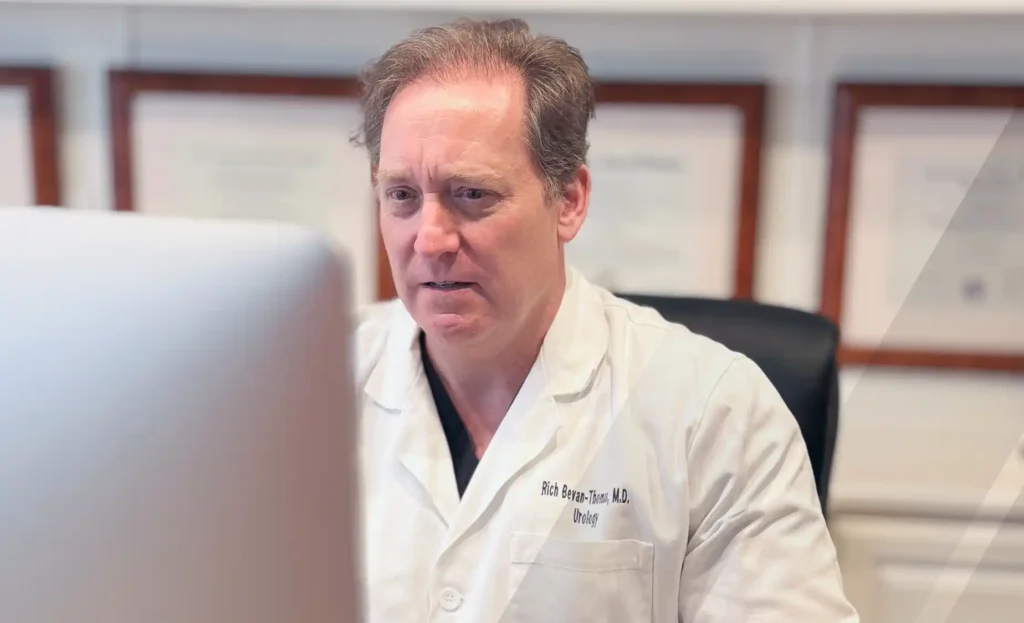
You are not alone in this journey. Dr. Bevan-Thomas specializes in creating clear, personalized treatment plans utilizing the most advanced, minimally invasive approaches—including Robotic Prostatectomy—to ensure the best possible outcomes while preserving your quality of life.
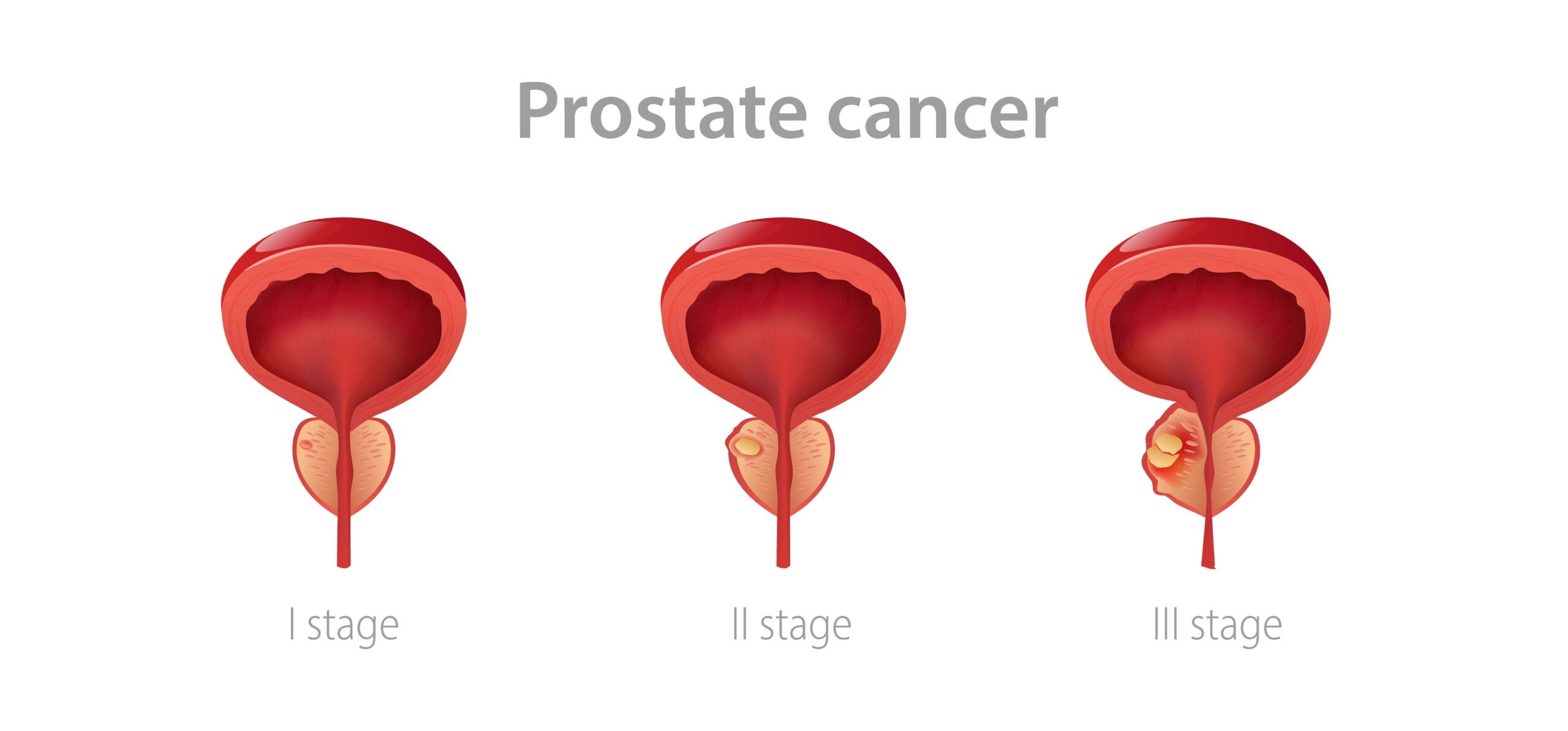
Explaining Prostate Cancer Stages (TNM System)
The stages of prostate cancer are defined by the TNM system (Tumor, Node, Metastasis), which describes the extent of the disease. In simpler terms, stages I, II, and III, as shown above, represent cancer that is considered localized or locally advanced, meaning the disease has not yet spread to distant parts of the body. Dr. Bevan-Thomas uses these stages—along with Gleason Grade Group, PSA level, and imaging—to determine the best course of action (e.g., Active Surveillance, Surgery, or Radiation).
Stage I
The cancer is small, low-grade, and confined entirely within the prostate gland. These cases often qualify for Active Surveillance.
Stage II
The tumor is still confined to the prostate, but it is either larger or has a higher grade. Treatment (surgery or radiation) is typically recommended, though favorable Stage II cases may qualify for structured Active Surveillance.
Stage III
The cancer has extended beyond the capsule of the prostate to nearby tissues (locally advanced) but has not yet spread to lymph nodes or other organs. These cases require aggressive treatment, often involving a combination of surgery and radiation.
Stage IV
The cancer has spread (metastasized) to distant lymph nodes, bones, or other organs outside the immediate pelvic area. Treatment focuses on controlling the disease and managing symptoms (systemic therapy).
UNDERSTANDING YOUR DIAGNOSIS:
Gleason Score & Grade Group
When your biopsy is reviewed by a pathologist, each sample is analyzed to determine how aggressive the cancer cells appear. These findings form the foundation of your treatment plan.
What Does My Pathology Report Mean?
When your biopsy is reviewed by a pathologist, each sample is analyzed to determine how aggressive the cancer cells appear. These findings form the foundation of your treatment plan.
Gleason Score
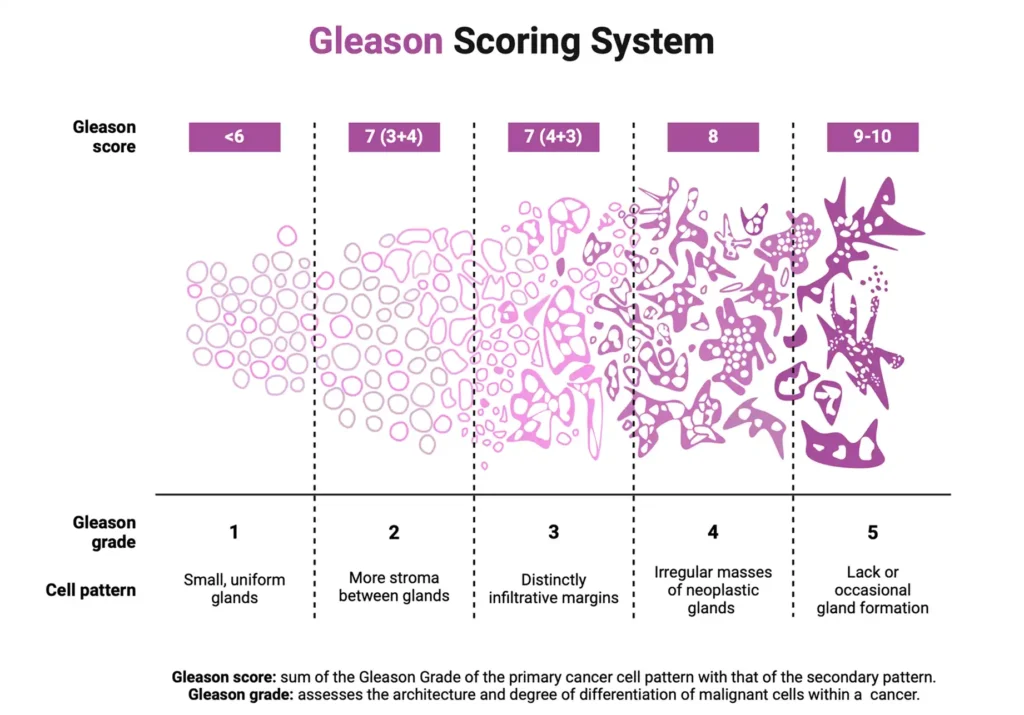
The Gleason score combines two patterns your pathologist sees under the microscope:
- Primary pattern: The most common cell type in the biopsy
- Secondary pattern: The second most common type.
These are added together (for example, 3 + 4 = 7) to estimate how likely the cancer is to grow or spread.
A lower number usually means a slower-growing cancer, while higher numbers suggest a more aggressive form.
Grade Groups
Introducing the Grade Group
This is the most important addition, as the Grade Group system is the most modern, clinically relevant way to communicate prostate cancer risk.
The Modern Grade Group System: To simplify risk assessment, the Gleason Score is converted into a Grade Group (1 to 5). This is the metric Dr. Bevan-Thomas uses to recommend treatment.
- Grade Group 1 (Gleason 6): Low risk. Often eligible for Active Surveillance.
- Grade Group 2 (Gleason 3+4=7): Favorable Intermediate Risk. Treatment or structured Active Surveillance.
- Grade Group 3 (Gleason 4+3=7): Unfavorable Intermediate Risk. Treatment is typically recommended.
- Grade Group 4 (Gleason 8): High Risk.
- Grade Group 5 (Gleason 9 or 10): Very High Risk.
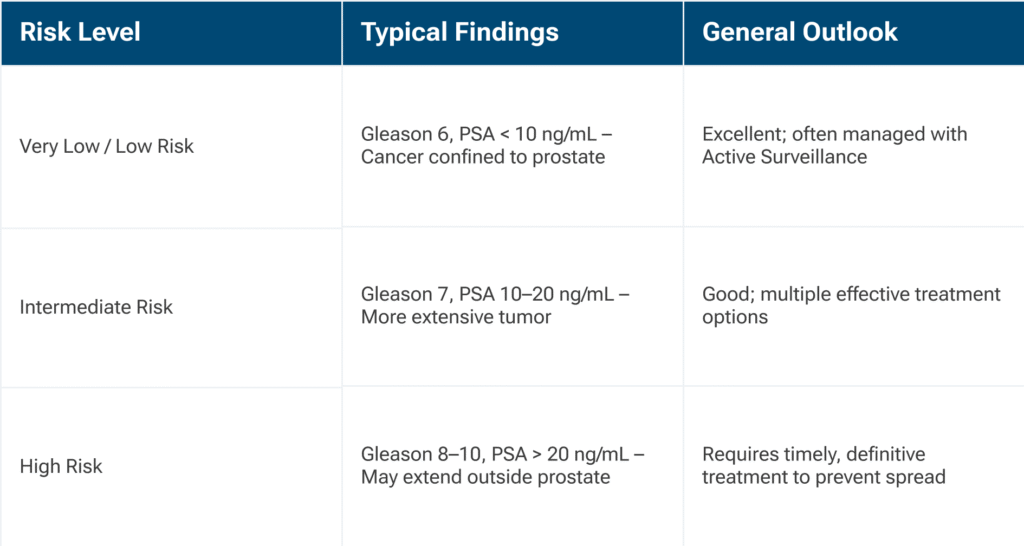
WHAT "RISK" REALLY MEANS: NCCN Risk Categories
We combine your Gleason score, PSA level, and exam findings to determine your NCCN risk category.
Risk helps estimate how likely the cancer is to grow, spread outside the prostate, or progress elsewhere in the body.
This information guides whether observation, focal therapy, or definitive treatment is safest for you.
MOLECULAR & GENOMIC TESTING for Precision Prostate Cancer Planning
Sometimes, biopsy results leave gray areas between treatment and observation. That’s where genomic testing helps.
Tests such as Polaris, Oncotype DX GPS, and Decipher analyze the genetic activity of your cancer cells to predict how aggressive the tumor may be.
These insights help answer key questions:
- Is the cancer safe to monitor, or should we treat now?
- Which treatment offers the best chance for cure?
Think of it as a genetic fingerprint that personalizes your care—beyond what standard numbers can show.

DO I NEED MORE SCANS? Advanced Prostate Cancer Staging
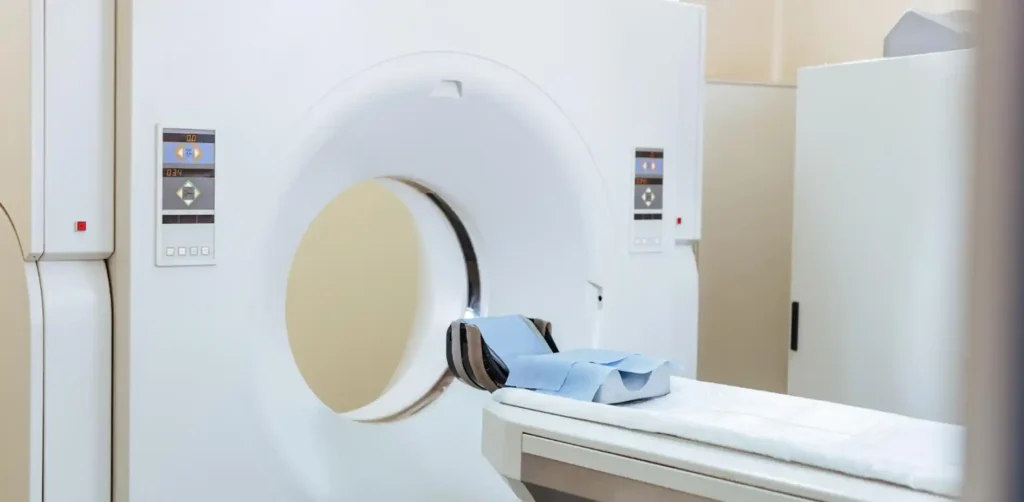
For men with intermediate or high-risk disease, we may order advanced imaging to ensure the cancer hasn’t spread beyond the prostate.
- PSMA PET Scan: The new gold standard for detecting prostate cancer anywhere in the body.
- Prostate MRI: Creates a detailed internal map of the prostate for precise planning before treatment or surgery.</b
These scans guide us in choosing the most effective therapy—whether the cancer is confined or has become more advanced.
Personalized Prostate Cancer Treatment Options
At Urology Partners, there is no one-size-fits-all approach. Every plan is designed around your diagnosis, health, and lifestyle.
Active Surveillance
A proactive strategy for low-risk cancers—close monitoring with PSA, MRI, and periodic biopsy—to avoid unnecessary treatment while maintaining safety.
Focal Therapy with NanoKnife
Focal Therapy with NanoKnife® (IRE): Targets only the cancerous area, sparing healthy tissue and minimizing side effects for maximal functional preservation.
Catheter-Free Robotic Prostatectomy
Catheter-Free Robotic Prostatectomy (RASP): Minimally invasive surgical removal using the da Vinci system. Dr. Bevan-Thomas’s catheter-free technique improves comfort and recovery.
IMRT with Barrigel
IMRT with Barrigel® / SpaceOAR®: Highly targeted radiation therapy with a protective hydrogel spacer that shields nearby organs to reduce long-term bowel side effects.
Cryoablation (Cancer Freezing)
| Cryoablation (Cancer Freezing): A precise, minimally invasive freezing technique that destroys cancer cells—an effective option, even for salvage treatment after prior radiation. |
Schedule Your Consultation
Take control of your prostate health today. Schedule a consultation with Dr. Bevan-Thomas to explore every modern option, including Active Surveillance, Robotic Surgery, Focal Therapy, and Coordinated Radiation—right here in Arlington and Dallas-Fort Worth.
- 866-367-8768
- 801 West I-20 Suite 1 • Arlington TX 76017
Why Patients Across North Texas Choose Dr. Bevan-Thomas
- Board Certified by the American Board of Urology
- MD Anderson and UT Houston: MD Anderson and UT Houston Training: Signifies training at world-class cancer centers.
- Innovator in Minimally Invasive Procedures – NanoKnife, Fusion Biopsy, Robotic Surgery: Innovator in Minimally Invasive Prostate Procedures: Focusing on NanoKnife Focal Therapy, MRI-Fusion Biopsy, and Robotic Surgery.
- UPNT Physician of the Year 2024: UPNT Physician of the Year 2024: Recognized locally for excellence in clinical care and leadership.
- Over 3,000 Robotic Prostate Procedures Performed

Frequently Asked Questions
What does my Gleason score really mean?
It measures how aggressive your cancer appears under the microscope and helps guide treatment choices.
Do all prostate cancers need treatment right away?
No. Many early-stage cancers can be safely observed through Active Surveillance.
When is robotic surgery the best option?
For localized or intermediate-risk cancer when patients want the most definitive cure with faster recovery.
Can prostate cancer return after treatment?
Yes, but modern imaging and salvage therapies allow us to successfully manage recurrent disease.