
Multiparametric Prostate MRI (mpMRI) in Arlington & Dallas–Fort Worth, TX
Multiparametric Prostate MRI (mpMRI) is the most advanced non-invasive tool available for accurately detecting and localizing clinically significant prostate cancer. We recommend Gateway Imaging for the best result for your prostate MRI. Dr. Bevan-Thomas personally reviews your MRI with you—including second opinions on outside MRIs—and then we discuss the precise next steps together.
WHY mpMRI MATTERS: A Diagnostic Advantage Since 2011
A concerning PSA used to mean a random biopsy—missing important cancers and finding many that never needed treatment. Since 2011, Dr. Richard Bevan-Thomas has integrated multiparametric MRI (mpMRI) to:
- Clarify risk before biopsy.
- Target suspicious areas when a biopsy is needed.
- Support safer monitoring for men on active surveillance.
mpMRI is central to how we help patients across Arlington and the Dallas–Fort Worth area make informed, confident decisions.
WHAT mpMRI SHOWS
(The Imaging Components & PI-RADS Foundation)
MRI uses strong magnets and radio waves—not radiation—to create detailed images. A multiparametric study combines complementary sequences in one visit to reveal both anatomy and tissue behavior:
- T2-weighted imaging (anatomy): Clear detail of the gland, capsule, and zones.
- Diffusion-weighted imaging (DWI): How water moves through tissue (changes with cell density).
- Dynamic contrast–enhanced (DCE): Blood-flow patterns (used selectively).
Where you’ll have the scan: Your MRI is performed at Gateway Imaging, which we recommend for the best result. A typical prostate MRI takes about 45 minutes.
Interpreting Results
PI-RADS & PSA DENSITY: Expert Review for Prostate Cancer Risk
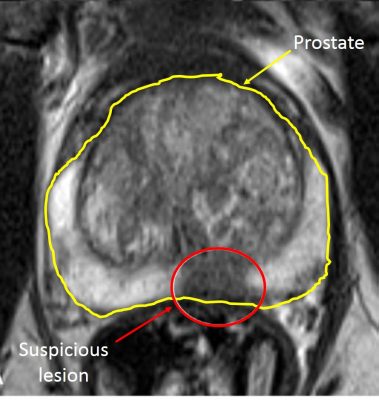
Dr. Bevan-Thomas personally reviews the MRI images and report with you—often serving as a second opinion—and explains how the findings relate to your history and goals.
Radiologists use PI-RADS to grade how suspicious a region appears:
| PI-RADS | Likelihood of Clinically Significant Cancer | Approx. Probability |
|---|---|---|
| 1 | Very low | <5% |
| 2 | Very low | 5–10% |
| 3 | Low | 10–20% |
| 4 | Moderate | 30-50% |
| 5 | Very high | 90-95% |
We also calculate PSA density (PSAD = PSA ÷ prostate volume). Low PSAD (<0.15) and PI-RADS 1–2 often mean biopsy avoidance. High PSAD or PI-RADS 4–5 means we proceed with an MRI-targeted biopsy.
THE “GRAY ZONE” (PI-RADS 3) & SECOND OPINIONS: Advanced Risk Stratification
- PI-RADS 3 Strategy: For equivocal findings, Dr. Bevan-Thomas frequently adds ExoDx Prostate (ExosomeDx) biomarker testing to refine risk. Low ExoDx + low PSAD may allow surveillance.
- Second Opinions: Already had an MRI elsewhere? Bring your DICOM images and report. Dr. Bevan-Thomas is one of the few urologists who routinely reviews the actual MRI images with you, so you fully understand what they show.

How mpMRI and MRI–Ultrasound Fusion Biopsy Fit Together
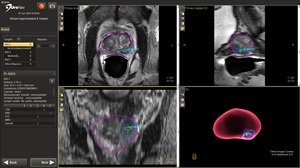
mpMRI comes first. If the scan shows PI-RADS 3, 4, or 5—or if overall risk remains elevated—we may recommend an MRI–ultrasound fusion biopsy, which uses your MRI map with real-time ultrasound to precisely target and sample suspicious areas.
- Our team has performed well over 5,000 MRI–ultrasound fusion biopsies , bringing deep image-guided expertise to every consult.
Our Step-by-Step Pathway
Our Pathway to Precision: We use the mpMRI as the critical step to avoid unnecessary random biopsies. The image-guided pathway ensures we detect and accurately sample only clinically significant cancer, sparing you unnecessary procedures.
- Consultation: History, PSA trends, risk factors, and your goals.
- mpMRI at Gateway Imaging: About 45 minutes; oral sedation available if needed.
- Personal Review with Dr. Bevan-Thomas: He reviews your actual MRI images and explains PI-RADS and PSA density.
- Plan: Observation, biomarker testing (e.g., ExoDx), or MRI-targeted fusion biopsy when indicated.
- Follow-through: Clear timelines for follow-up PSA/MRI or biopsy so you’re never left guessing.


About Dr. Rich Bevan-Thomas
- Robotic Surgery Volume: Over 3,000 robotic surgeries since 2002; refined catheter-free suprapubic recovery protocol.
- Technique: Meticulous nerve-sparing and endopelvic fascia-sparing techniques to support erections and early continence.
- Full Spectrum: Full-Spectrum Urologic Solutions: Offering advanced therapies, including Robotic Surgery (RALP), NanoKnife® (IRE) focal therapy, full-gland cryoablation, coordinated IMRT, and expert management for early-stage prostate cancer.

Schedule your mpMRI or second-opinion review
If your PSA is elevated, if a biopsy has been recommended, or if you’d like a second opinion on an outside MRI, a multiparametric MRI can clarify the path forward.
- 866-367-8768
- 801 West I-20 Suite 1 • Arlington TX 76017