
Why Your “Heart-Healthy” Baby Aspirin Could Delay Surgery

Many patients are surprised when I tell them:
“Even baby aspirin can delay your surgery.” They know aspirin is over the counter.
They have heard it protects the heart. It feels harmless.
But aspirin is not harmless before surgery.
For patients undergoing robotic prostatectomy, kidney stone procedures, bladder surgery, or other urologic operations, aspirin can meaningfully increase bleeding risk. In some cases, it is enough to postpone a procedure for safety.
Here is why.
Why Aspirin Is So Widely Used
Aspirin is an antiplatelet medication. It reduces the ability of platelets to form clots inside arteries.
For patients with coronary stents, prior heart attack, prior stroke, diabetes, or significant cardiovascular risk factors, aspirin lowers the chance of another major cardiac event. In the right setting, it saves lives.
That is why it is so widely recommended. Even low-dose aspirin at 81 mg daily provides meaningful platelet inhibition.
The same mechanism that protects the heart, however, affects surgery.
How Aspirin Affects Clotting
Aspirin irreversibly inhibits cyclooxygenase-1, the enzyme responsible for platelet activation. Once a platelet is exposed to aspirin, it loses its ability to form an effective clot.
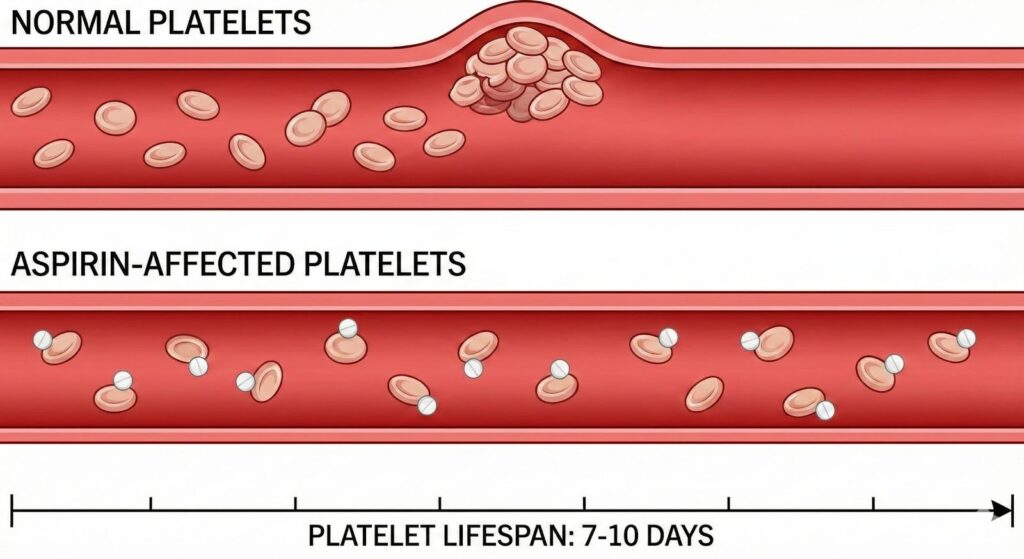
Platelets do not regenerate. Once inhibited, they remain impaired for their entire lifespan, which is approximately 7 to 10 days.
This means that even a single 81 mg tablet can affect clotting for more than a week. From a cardiology standpoint, this reduces arterial clot formation.
From a surgical standpoint, it increases bleeding risk.
Why This Matters in the Operating Room
Every surgical procedure carries some degree of bleeding risk.
Even in minimally invasive robotic surgery, precision depends on a clear operative field. Excess bleeding can obscure visualization, prolong operative time, and increase the likelihood of complications.
Impaired platelet function can contribute to:
- Increased intraoperative bleeding
- Postoperative hematoma formation
- Higher transfusion rates
- Delayed recovery
This applies not only to major operations such as robotic prostatectomy, but also to endoscopic and stone procedures.
For that reason, we routinely review aspirin and other medications before scheduling surgery.
How Long Before Surgery Should Aspirin Be Stopped?
Although aspirin clears the bloodstream quickly, its effect on platelets persists. After stopping aspirin:
- Days 1 through 3: Minimal improvement in platelet function
- Around Day 5: Approximately 50 percent platelet recovery
- Around Day 7: Significant functional recovery
- By Day 10: Near complete restoration of platelet activity
For most patients, we recommend discontinuing aspirin 7 to 10 days before surgery.
The exact timing depends on your medical history and the type of procedure being performed.
Balancing Cardiac Risk and Surgical Safety
Stopping aspirin is not always simple.
Patients with recent coronary stents, prior myocardial infarction, or high cardiovascular risk may not be able to safely discontinue antiplatelet therapy.
In those cases, we coordinate directly with cardiology to determine the safest approach. The objective is not simply to stop medication. The objective is to balance clotting risk and bleeding risk in a way that protects both the heart and the surgical outcome.
There is no one-size-fits-all answer. Each decision is individualized.
A Common Scenario
I have had patients arrive on the morning of surgery unaware that their daily baby aspirin was relevant.
Occasionally, this results in rescheduling. Not because the surgery is unimportant, but because safety comes first.
Clear communication before surgery prevents unnecessary delays and reduces avoidable risk.
What You Should Do Before Surgery

If you are taking aspirin, even low-dose 81 mg, take the following steps:
- Inform your surgeon and anesthesiologist of all medications and supplements
- Do not stop aspirin without speaking to your surgeon or cardiologist
- Be specific about your dose and schedule
- Follow the instructions you are given regarding when to stop and when to restart
Preparation is part of surgical safety.
Final Takeaway
Aspirin is one of the most important medications in modern cardiovascular care. Used appropriately, it reduces heart attack and stroke risk.
Before surgery, however, even low-dose aspirin meaningfully alters clotting.
If you are scheduled for a procedure, review your medications carefully. Inform your surgical team of everything you are taking. Do not assume that a small pill means small impact.
Surgical safety begins with preparation.
Call: 866-367-8768
Location: Urology Partners of North Texas | Arlington, TX
Book Online: Schedule Your Consultation
Watch: Cancer Control & Robotic Surgery on the DocRBT YouTube Channel