In 2026, more men with prostate cancer are asking a reasonable question:
If my cancer appears to be limited to one area of the prostate, do I really need to treat the entire gland?
For many years, prostate cancer treatment often felt like an all-or-nothing decision. Either monitor the cancer with active surveillance, or treat the whole prostate with surgery or radiation.
Those options are still important. Some men absolutely need surgery. Some are better served with radiation. Some are safest with active surveillance.
But for carefully selected men with one clearly defined area of prostate cancer, there may be another option: focal therapy with NanoKnife.
NanoKnife uses a technology called irreversible electroporation, or IRE, to target a specific area of prostate tissue. The goal is to destroy the cancer focus while preserving as much normal prostate tissue as possible.
In plain English:
Treat the cancer. Preserve the man.
NanoKnife is not right for everyone. But for the right patient, it can be a compelling middle ground between active surveillance and whole-prostate treatment.
What Is Focal Therapy?
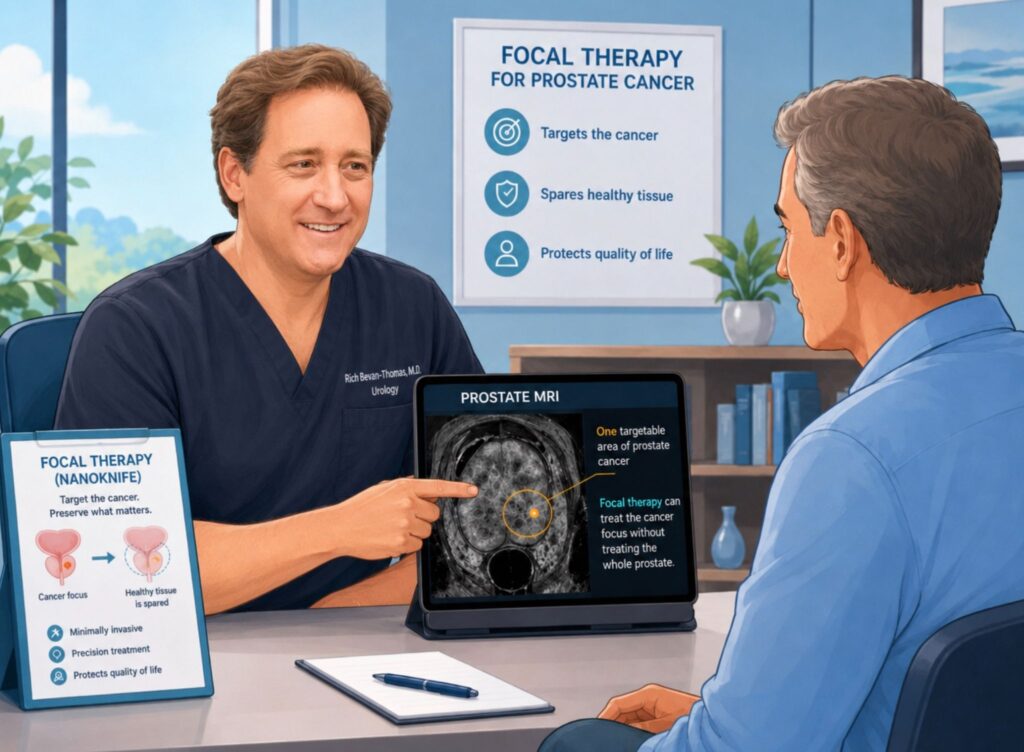
Focal therapy means treating only the part of the prostate where the significant cancer is located, instead of treating the entire gland.
That is the core idea.
With robotic prostatectomy, the entire prostate is removed. With radiation, the whole prostate is usually treated. Those treatments can be very effective and remain the right choice for many men.
NanoKnife is different.
It is designed for men whose cancer appears to be in one dominant, targetable area. That area may be on one side of the prostate, or it may be one specific region that can be seen on MRI and confirmed with biopsy.
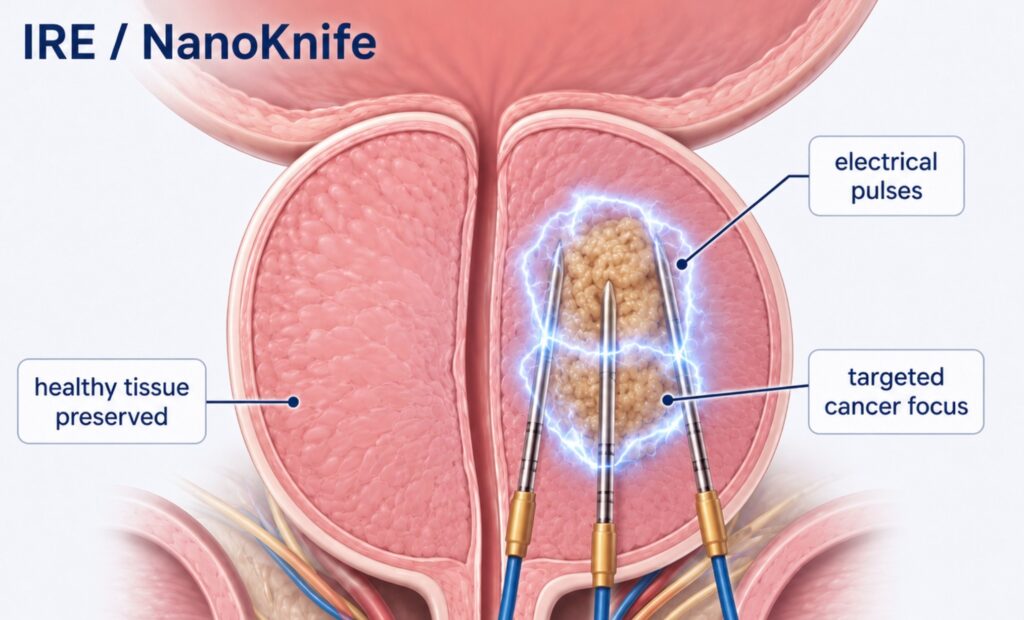
The goal is not to randomly treat the whole prostate. The goal is to create a focused treatment zone around the known cancer.
That matters because the prostate sits next to structures that are important for urinary control and sexual function. If we can treat the cancer focus without unnecessarily damaging the rest of the prostate and surrounding tissues, we may be able to reduce side effects in appropriately selected patients.
How NanoKnife Works
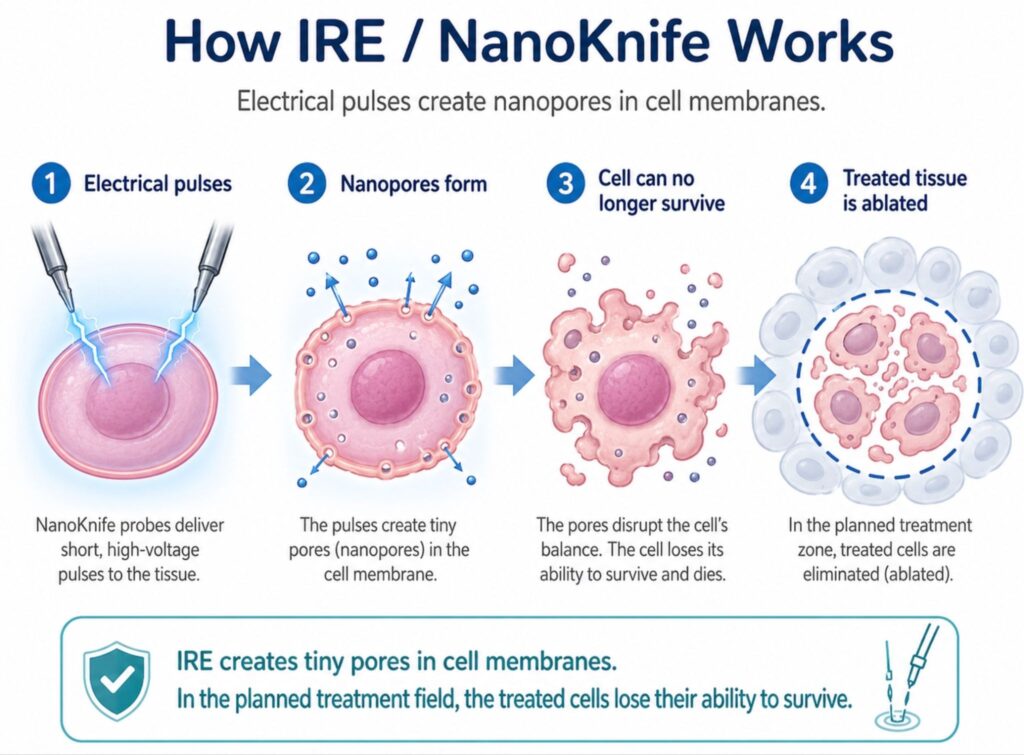
NanoKnife uses irreversible electroporation, also called IRE.
Unlike treatments that burn tissue with heat or freeze tissue with extreme cold, NanoKnife uses short electrical pulses delivered through small needle-like probes placed into the prostate. These pulses create tiny openings in the membranes of targeted cells. When enough damage occurs, those cells can no longer survive and die off over time.
That is why NanoKnife is often described as a non-thermal ablation treatment.
The word non-thermal is important. Because NanoKnife does not rely on heat or freezing, the treatment does not depend on thermal spread through the tissue. The electrical treatment field is carefully planned around the tumor, with the goal of staying focused on the cancerous area inside the prostate while minimizing unnecessary injury to nearby structures.
The NanoKnife system has FDA clearance for surgical ablation of soft tissue, including prostate tissue, and the FDA summary describes the system as using irreversible electroporation to ablate targeted tissue.
Why MRI and Biopsy Results Matter
Focal therapy is only as good as the map.
If we are going to treat one area of the prostate, we need to know where the meaningful cancer is located.
That usually requires a high-quality prostate MRI and targeted biopsy. MRI can show suspicious areas in the prostate. Fusion biopsy allows us to sample those MRI-visible lesions while also checking the rest of the gland.
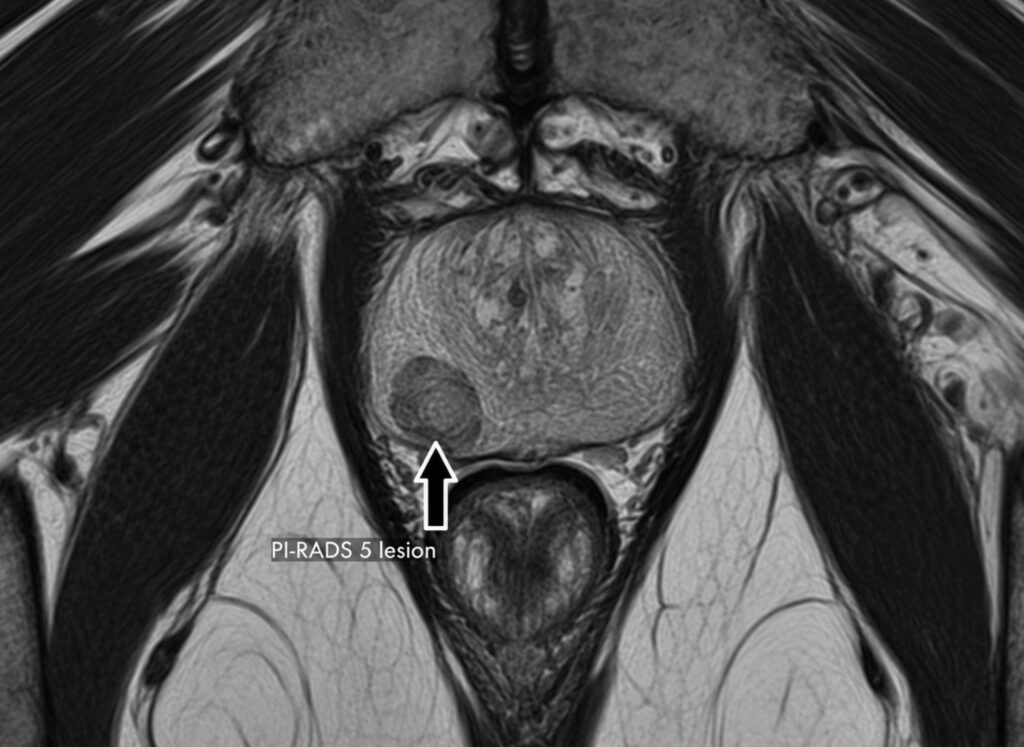
Before considering NanoKnife, we need to answer several important questions:
- Where is the cancer?
- How aggressive is it?
- Is there significant cancer somewhere else in the prostate?
- Does the cancer appear contained within the prostate?
- Is there one dominant area that can be safely targeted?
If the MRI and biopsy show one dominant targetable area, focal therapy may make sense.
If the cancer is high-volume, scattered throughout the prostate, very aggressive, or poorly defined on imaging, then treating only one area may not be enough. In those cases, surgery, radiation, or another treatment approach may be more appropriate.
Who May Be a Good Candidate for NanoKnife?
In my practice, I typically consider NanoKnife for men who appear to have one clearly defined area of prostate cancer that can be targeted.
A potential candidate may have:
- One dominant area of prostate cancer
- Cancer mainly on one side of the prostate
- A lesion visible on prostate MRI
- Biopsy results confirming the location and grade of the cancer
- No clear evidence that the cancer has spread outside the prostate
- A desire to treat the cancer while trying to preserve urinary and sexual function
- A clear understanding that follow-up is still required
The ideal patient is not someone with cancer scattered throughout the entire prostate. The ideal patient is someone with a cancer focus that can be accurately mapped and treated.
This decision cannot be made from the PSA alone. It requires a careful review of the MRI, biopsy results, cancer grade, prostate anatomy, risk category, and the patient’s goals.
Who May Not Be a Good Candidate?
NanoKnife is not for every prostate cancer.
It may not be appropriate for men with:
- Cancer in multiple areas of the prostate
- High-volume disease
- Very aggressive cancer features
- Cancer that is not clearly visible or targetable
- Evidence that cancer has spread outside the prostate
- A situation where whole-gland treatment would be safer or more effective
This is one of the most important parts of the consultation. The goal is not to force every patient into focal therapy. The goal is to determine whether focal therapy fits the cancer.
What Happens During the Procedure?
I perform NanoKnife at the surgery center, usually in under an hour.
The procedure is done under anesthesia. Small probes are placed into the prostate around the cancerous area. The placement is carefully planned so the electrical treatment field surrounds the target zone.
That planning is critical.
The goal is to keep the treatment focused on the cancerous area inside the prostate while minimizing unnecessary injury to nearby structures involved in urinary control and sexual function.
A catheter may be used temporarily while swelling settles down. Most patients go home the same day, depending on the specific situation and recovery from anesthesia.
Most patients can gradually return to normal activity as they recover. In my protocol, patients generally have no restrictions after 2 weeks, assuming they are healing well and there are no individual concerns.
What Are the Potential Benefits?
The biggest potential benefit of NanoKnife is precision.
NanoKnife is designed to treat a targetable cancer area without removing or radiating the entire prostate.
For carefully selected patients, potential advantages may include:
- No prostate removal
- No radiation exposure
- A focused treatment zone
- Less disruption of normal prostate tissue
- Faster recovery than major surgery
- Lower risk of urinary leakage than whole-gland treatment in appropriately selected patients
- Better chance of preserving sexual function compared with more aggressive whole-prostate treatment, depending on cancer location and baseline function
But NanoKnife is not magic.
It is a tool. A promising tool, but still a tool. The outcome depends on the cancer, the imaging, the biopsy, the treatment plan, the patient’s anatomy, and the follow-up.
What Does the Recurrence Data Show?
When patients ask about NanoKnife, one of the most important questions is:
How often does the cancer come back?
The answer depends on what we mean by “come back.”
With focal therapy, there are two different issues:
In-field recurrence means cancer found again inside the area that was treated.
Out-of-field cancer means cancer found somewhere else in the prostate, outside the treated zone.
That distinction matters because NanoKnife does not remove or treat the entire prostate. It is designed to target the known cancer area while preserving as much normal tissue as possible.
In well-selected patients, early studies have reported relatively low rates of clinically significant cancer returning in the treated zone, often around 10% or less. Published NanoKnife data have reported in-field recurrence around 9.8% in one series and clinically significant cancer in the treated area around 9.9% on repeat biopsy in another study, depending on the study design and definition used.
That is encouraging, but it has to be understood correctly.
A low in-field recurrence rate does not mean the entire prostate is “cured forever.” It means the treated zone appears to be well controlled in many carefully selected patients. Because the rest of the prostate remains in place, cancer can still be found elsewhere in the gland over time.
That is why follow-up after NanoKnife is not optional. Patients still need PSA monitoring, repeat MRI when appropriate, and sometimes repeat biopsy.
The Bottom Line
NanoKnife is one of the most important focal therapy conversations in prostate cancer for 2026.
For the right patient, it may offer a way to treat a defined prostate cancer focus without removing or radiating the entire prostate.
That is the key idea:
Treat the cancer focus. Preserve as much normal prostate as possible. Keep watching carefully.
NanoKnife is not for every man. It is not a shortcut. It is not a guarantee. It is a focused treatment strategy that depends on accurate diagnosis, careful planning, and long-term surveillance.
The American Urological Association notes that focal therapy approaches, including IRE, are still undergoing extensive evaluation in prospective studies, which is why careful counseling and patient selection are so important.
For the right patient, though, NanoKnife can be a powerful option to discuss.
Schedule a NanoKnife Consultation in Arlington, TX
If you have been diagnosed with localized prostate cancer and want to understand whether focal therapy may be appropriate, Dr. Richard Bevan-Thomas can help you review your options.
At our Arlington office, we evaluate your PSA, MRI, biopsy results, cancer grade, prostate anatomy, health history, and personal priorities to determine whether NanoKnife may be reasonable.
The goal is not to push one treatment.
The goal is to find the right treatment for you.
Schedule a consultation with Dr. Richard Bevan-Thomas in Arlington to discuss whether NanoKnife focal therapy is an option for your prostate cancer.